

Bookkeeping hub
Keep your books right, all year round.
Check how your bookkeeping is doing, see whether you need to register for VAT, learn the mistakes that cost money, and download free checklists, from the bookkeeping bureau at Errington Langer Pinner.
- 2 quick checks
- 4 free PDFs
- Written by chartered accountants
Your bookkeeping year
Three rhythms. Keep to them and the year end takes care of itself.
- Every month
- Record every sale and purchase
- Keep each receipt (a photo is fine)
- Reconcile your bank account
- Every quarter
- VAT return, if you are registered
- Making Tax Digital update, if it applies
- Set money aside for tax
- At the year end
- Stock, debtors and creditors
- Assets bought or sold
- Accounts and tax return
Bookkeeping health check
Six questions, thirty seconds.
Answer honestly. The meter shows how your bookkeeping is doing, and what to look at first.
Six mistakes that cost money
The ones we put right most often, and how to avoid them.
- Mixing business and personal money One account for everything makes it hard to prove what is a business cost. Open a separate business account.
- Losing receipts No receipt often means no claim. Photograph receipts the day you get them, before they fade.
- Leaving it all to the year end Twelve months of records in one go leads to missed expenses and rushed returns. Little and often is quicker.
- Not reconciling the bank Without a monthly check against your statement, errors and missing entries go unnoticed.
- Getting VAT wrong Charging VAT when you are not registered, or claiming it without a valid invoice, causes trouble with HMRC.
- Forgetting cash and small sales Cash takings and online sales all count as income, and online platforms now report sellers to HMRC.
What is bookkeeping? Do your books in 5 easy steps
A plain-English guide for UK sole traders, landlords and small businesses: a separate bank account, keeping receipts, recording and categorising transactions, and reconciling.
Do you need to register for VAT?
You must register once your taxable turnover goes over £90,000.
Add up your VAT-taxable sales for the last 12 months (not just this tax year). You must also register if you expect to go over £90,000 in the next 30 days alone.
- 20%
- Standard rate of VAT
- £88,000
- You can deregister if turnover falls below this
- £150,000
- Turnover limit to join the Flat Rate Scheme
What poor bookkeeping can cost
Most penalties start with records that were not kept up to date.
- Up to £3,000
- Penalty for not keeping adequate records
- £100
- Automatic penalty for a late Self Assessment return, even if no tax is due
- £200
- For each late VAT return once you reach the penalty point threshold (4 points for quarterly returns)
- Pay, or agree a plan, by day 15: interest only
- From day 16: 3% of what is still unpaid
- From day 31: another 3%, then 10% a year
How long to keep your records
HMRC can ask to see them. Keep receipts, invoices and bank statements for at least these periods.
| Sole traders and landlords | ||
|---|---|---|
| Limited companies | ||
| VAT-registered businesses | ||
Do it yourself, or let us do it?
Plenty of people keep their own books well. Here is what changes when our bureau takes over.
Bookkeeping jargon, explained
The words you will hear most, in plain English.
- Bank reconciliation
- Checking your records against your bank statement, so every payment in and out is recorded once.
- Cash basis
- Recording income and costs when the money actually comes in or goes out. The default for most sole traders and landlords.
- Accruals basis
- Recording income and costs when they are earned or incurred, even if not yet paid. Used by limited companies.
- Input and output VAT
- Output VAT is what you charge customers; input VAT is what you pay suppliers. You pay HMRC the difference.
- Debtors and creditors
- Debtors owe you money; creditors are people you owe money to.
- Quarterly update
- A summary of income and expenses sent to HMRC every three months under Making Tax Digital.
Bookkeeping questions
Still unsure? Call us on 020 8446 6911 or email bureau@elp-ca.co.uk.
What does a bookkeeper do?
A bookkeeper records your sales and purchases, keeps receipts and invoices in order, reconciles your bank account and prepares the figures for VAT returns, Making Tax Digital updates and your year-end accounts.
Do I need a bookkeeper or an accountant?
Bookkeeping is the day-to-day recording; an accountant prepares your accounts and tax returns and advises you. Our bureau does both, so the same team that keeps your books also prepares your accounts and tax return.
Who do you provide bookkeeping for?
Sole traders, landlords, limited companies, charities and residential management companies, across North Finchley, Barnet and wider London.
Can you take over my bookkeeping part way through the year?
Yes. We bring your records up to date from the last point they were complete, then keep them up to date every month.
Which bookkeeping software do you use?
We agree the software with you when you join, to suit your business and how you like to work.
Do I need to visit your office?
No. You can send records digitally and we are happy to meet online, or you are welcome at our office on the High Road in North Finchley.
Prefer us to do it for you?
Our bookkeeping bureau keeps your books right, every month.
- Monthly bookkeeping in software that suits you
- VAT returns and Making Tax Digital updates
- Payroll and CIS returns, if you need them
- Backed by a full ICAEW Chartered Accountancy practice
Free downloads
Print them, tick them off, and keep them with your records.
-
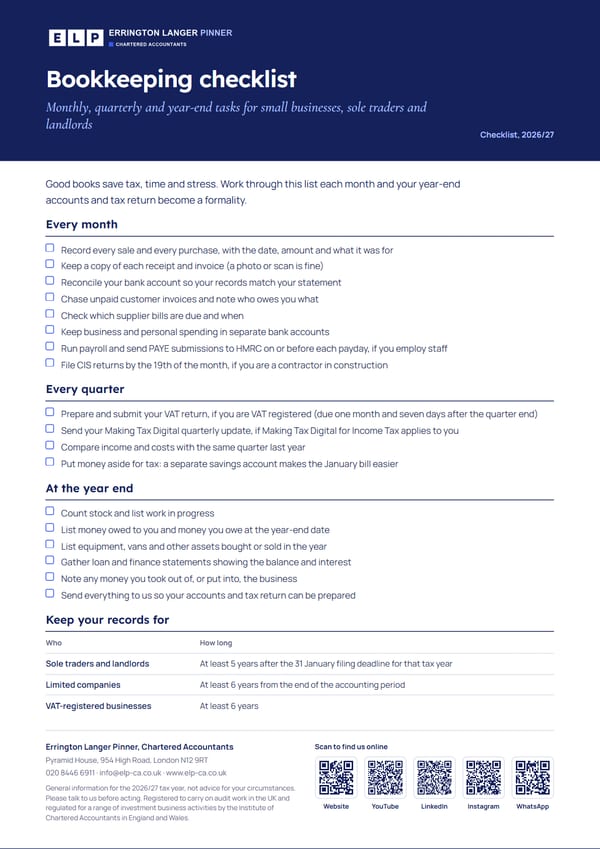 Checklist Bookkeeping checklist Monthly, quarterly and year-end tasks for small businesses, sole traders and landlords. Download
-
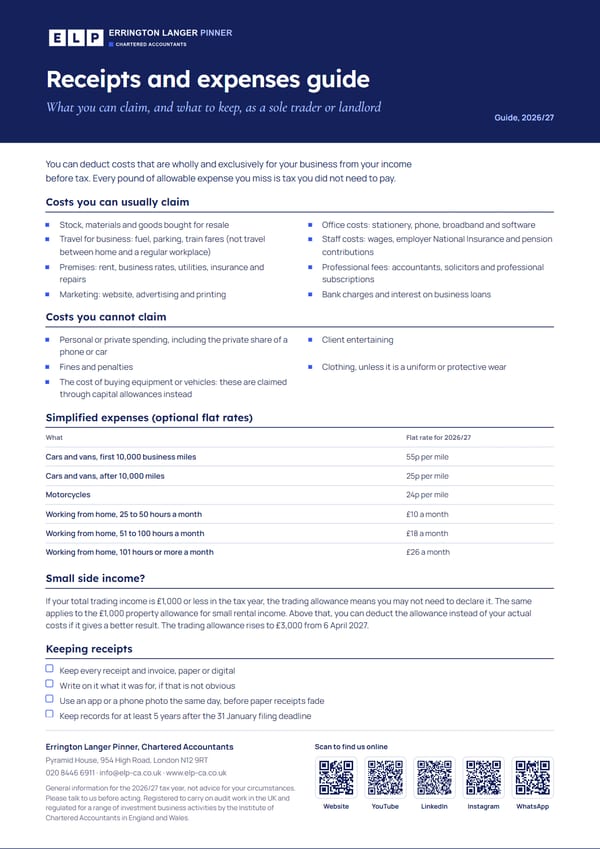 Guide Receipts and expenses guide What you can claim, and what to keep, as a sole trader or landlord. Download
-
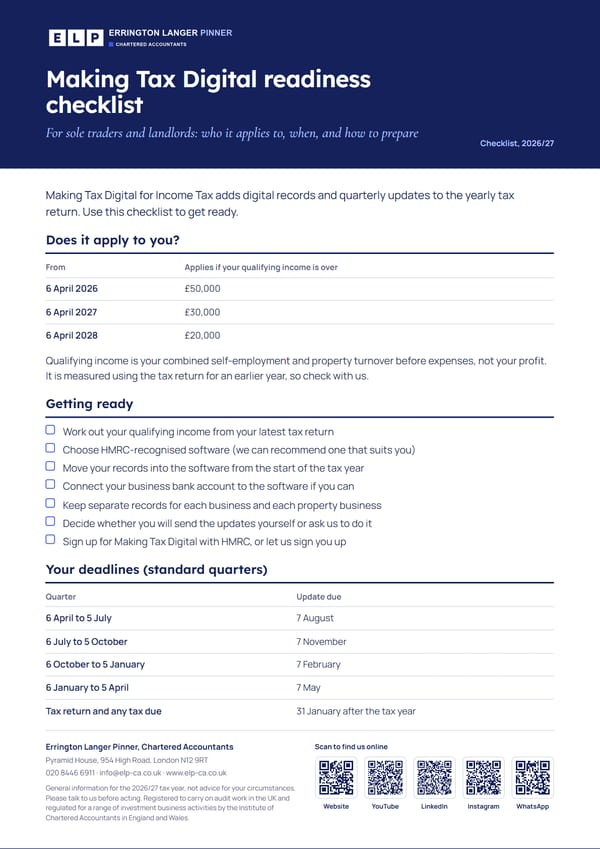 Checklist Making Tax Digital readiness checklist For sole traders and landlords: who it applies to, when, and how to prepare. Download
-
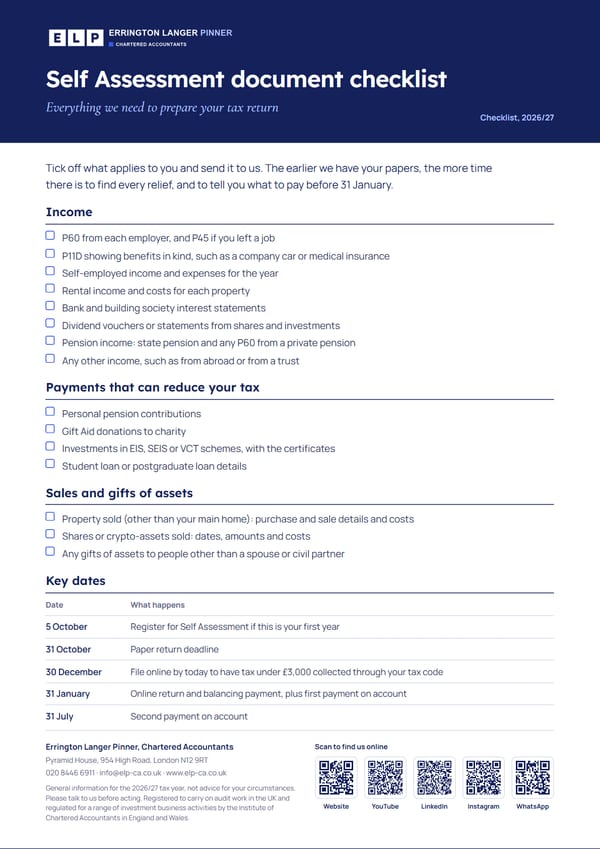 Checklist Self Assessment document checklist Everything we need to prepare your tax return. Download