

Making Tax Digital
For sole traders and landlords, from April 2027.
If your self-employed or rental income is over £30,000, you will need digital records and quarterly updates to HMRC. Check where you stand, see your deadlines, and let our bureau take care of it.
- Quick eligibility check
- Checked against GOV.UK
- Free checklist
Does it apply to you?
Add up your self-employed turnover and your share of rental income, before expenses.
Wages, dividends and pensions do not count. Type your figures and the scale shows where you stand.
Who joins, and when
Each April the threshold steps down, bringing in more people.
- From April 2026 The first group
- From April 2027 Many more sole traders and landlords
- From April 2028 Smaller businesses and lets
| What changes | Now | Becomes | From |
|---|---|---|---|
| Your records | Paper or spreadsheet | Digital, in compatible software | The April you join |
| Reporting during the year | None | Four quarterly updates | The April you join |
| Tax return | By 31 January | Still by 31 January | No change |
| Late filing | Fixed penalties | Penalty points | When you join |
Your first year
If you join in April 2027, these are your deadlines.
- Quarter 16 April to 5 July Update due7 August 2027
- Quarter 26 July to 5 October Update due7 November 2027
- Quarter 36 October to 5 January Update due7 February 2028
- Quarter 46 January to 5 April Update due7 May 2028
- Tax returnFor 2027/28 Return and tax due31 January 2029
Calendar quarters (to the end of June, September, December and March) are also allowed, with the same deadlines.
Penalties
A points system: one slip will not cost you, repeated ones will.
Source: GOV.UK guidance on Making Tax Digital for Income Tax, checked 18 November 2026.
- 1Missed deadline
- 2Another
- 3Another
- 4£200 penalty
After 4 points, every further missed deadline costs another £200. Late quarterly updates for 2026/27 do not earn points.
- 3% + 3%
- Late payment penalties for 2026/27: 3% of tax unpaid at day 15, another 3% at day 30, then 10% a year.
- 4% + 4%
- The same penalties from 2027/28, with the first two rates rising to 4%.
How we take care of it
From the first check to your tax return, one team looks after every step.
- We check where you standWe look at your latest tax return and tell you whether, and from when, Making Tax Digital applies to you.
- We agree your softwareWhen you join us, we choose HMRC-compatible software with you, to suit how you work.
- We set up your digital recordsYour records start from 6 April in the year you join, with bank feeds connected where possible.
- We keep your books up to dateOur bookkeeping bureau records and checks your income and expenses every month.
- We send every quarterly updateEach update goes to HMRC before its deadline, so you do not collect penalty points.
- We file your tax returnAt the year end we prepare your tax return, claim every allowance, and tell you what to pay by 31 January.
Let our bookkeeping bureau handle it
Your books kept up to date, your updates sent on time, every quarter.
- Monthly bookkeeping, checked by qualified accountants
- Quarterly updates sent to HMRC for you
- Your tax return prepared and filed by the same team
- An ICAEW Chartered Accountancy practice, established in 1994
Common questions
Still unsure? Call us on 020 8446 6911.
What counts as qualifying income?
Your income from self-employment and property, added together, before expenses. Employment income, dividends, pensions and partnership shares do not count.
I own a property jointly. What counts?
Only your share of the property income. For example, if a jointly owned property brings in £50,000 and you own half, £25,000 counts towards your qualifying income.
How does HMRC decide when I join?
HMRC uses the tax return you sent for an earlier year. Over £50,000 on your 2024/25 return means you joined from April 2026; over £30,000 on your 2025/26 return means April 2027; over £20,000 on your 2026/27 return means April 2028.
Do I still need to file a tax return?
Yes. The quarterly updates are summaries, not tax returns. You still file a tax return, and pay any tax due, by 31 January after the end of the tax year.
Can I keep using a spreadsheet?
Only with bridging software that links your spreadsheet to HMRC. Most people find compatible bookkeeping software simpler, and we can set it up for you.
What if I have no income in a quarter?
You still need to send the quarterly update, even if it shows no income.
Will HMRC write to me?
HMRC writes to people it expects to be affected, but you are still responsible for checking, even if no letter arrives.
Can I get an exemption?
Some people are exempt automatically, such as those with no National Insurance number before the tax year starts. If you cannot use digital tools, for example because of age, disability or where you live, you can apply to HMRC for an exemption.
What if my income falls below the threshold?
You can stop using Making Tax Digital once your qualifying income has been below the threshold for three tax years in a row.
Free downloads
Free to download and print.
-
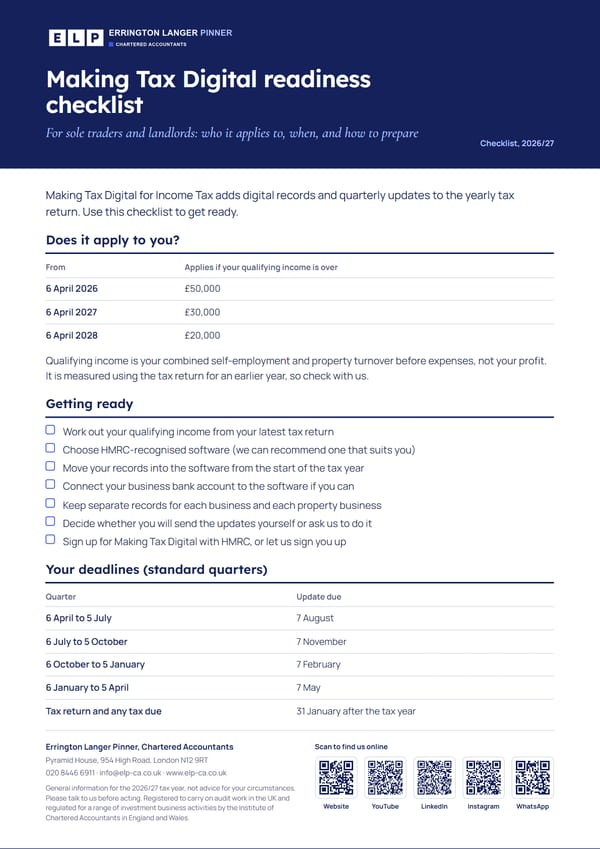 Checklist Making Tax Digital readiness checklist For sole traders and landlords: who it applies to, when, and how to prepare. Download
-
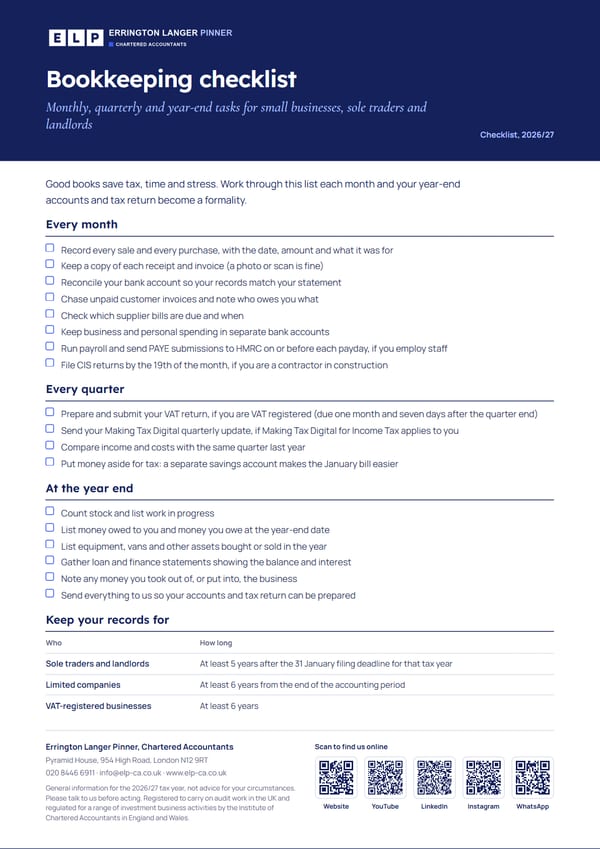 Checklist Bookkeeping checklist Monthly, quarterly and year-end tasks for small businesses, sole traders and landlords. Download
-
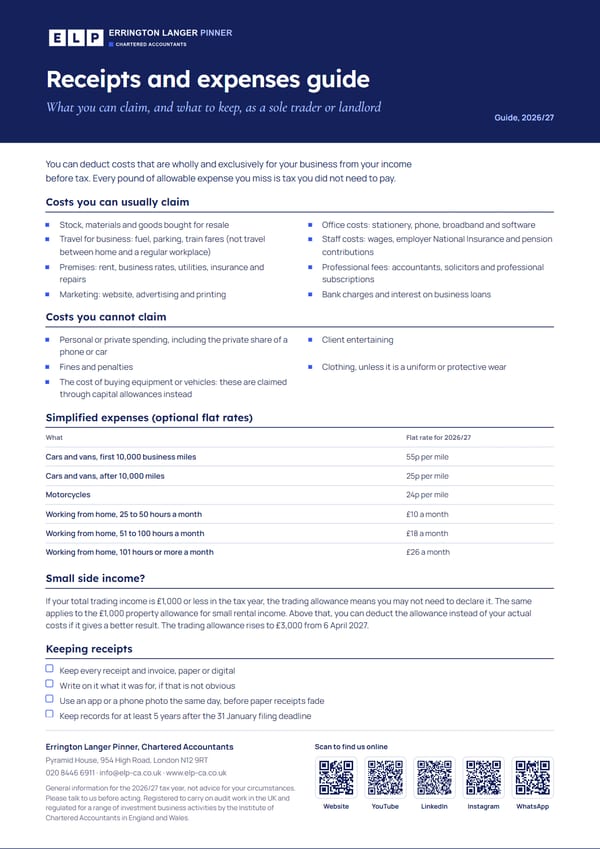 Guide Receipts and expenses guide What you can claim, and what to keep, as a sole trader or landlord. Download
-
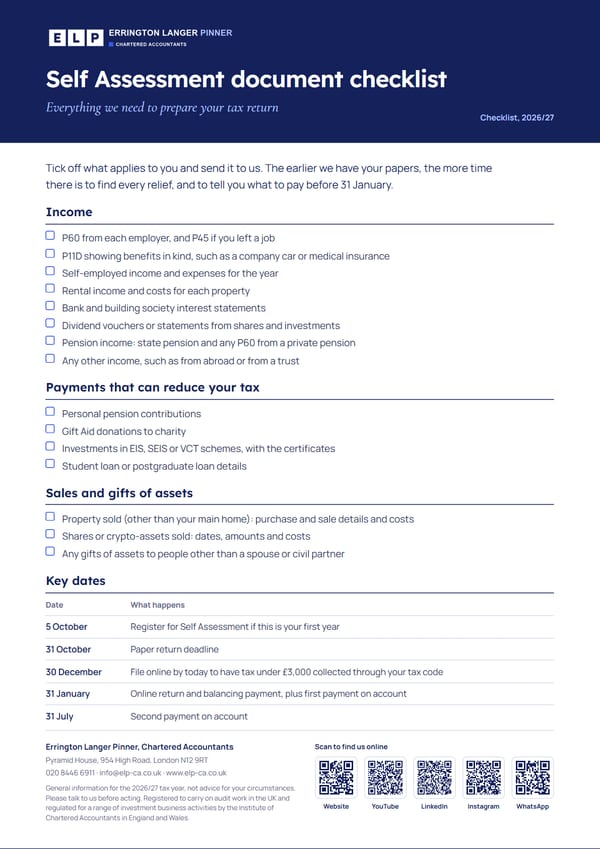 Checklist Self Assessment document checklist Everything we need to prepare your tax return. Download